Cisco ASR 9903 2T Multirate Port Expansion Card
2 Terabits of switching.
20 ports. One expansion slot.
The Cisco ASR 9903 2T Multirate Port Expansion Card turns a compact 3RU router into a 400 Gigabit Ethernet edge platform — without a chassis swap. Here’s the full data sheet, the ordering options, and how to get a quote.
What this card actually does
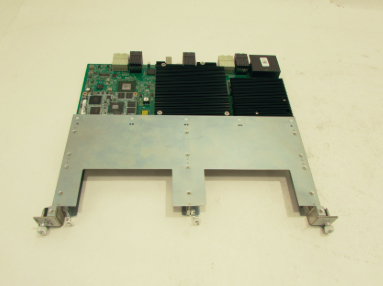
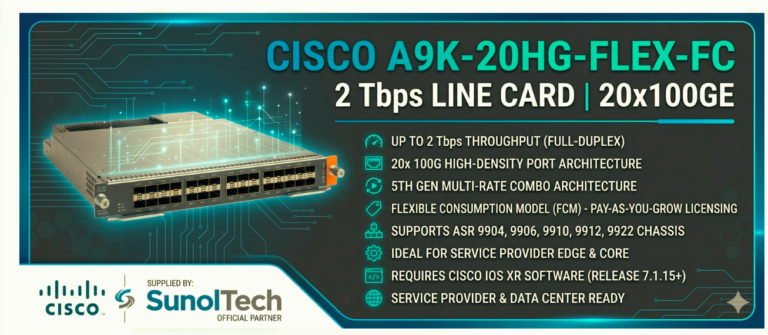
The ASR 9903 router ships with a fixed board that tops out at 1.6 Tbps across 16 integrated QSFP28 ports and 20 SFP+ ports. The A9903-20HG-PEC is the optional port expansion card that slots into the chassis’s dedicated PEC bay and adds a second 2 Tbps of switching capacity on top of that — without touching the rest of the router. In practice, that means an operator can deploy a single 3RU chassis at the network edge and grow it from a 100 Gigabit Ethernet aggregation box into a 400 Gigabit Ethernet-capable platform as traffic demands change, simply by adding this card and, where needed, a per-port software license.
Fifteen of the card’s twenty ports are fixed at 100GE over QSFP28 optics. The remaining five are multirate QSFP-DD cages that run at 100GE, 200GE, or 400GE out of the box, with each port individually upgradable to full 400GE through a Cisco Right-To-Use license — so you pay for headroom only when you actually need it, port by port, rather than licensing the whole card at once.
Why network teams spec this card
Five things that matter most when this card shows up in a bill of materials.
Mixed-rate flexibility
Run 10, 25, 40, 100, 200, and 400 Gigabit Ethernet side by side on the same card — no forklift upgrade required as link speeds change.
Pay-as-you-grow 400G
All five QSFP-DD ports ship 400GE-capable. Turn on full speed per port with a license only when traffic actually demands it.
Carrier-grade timing
Hardware-based IEEE 1588 PTP, SyncE, and GPS/BITS support keep this card in sync with mobile edge and 4G/5G timing requirements.
IOS XR consistency
Runs the same 64-bit Cisco IOS XR image as the rest of the ASR 9000 family, so operational tooling and automation carry straight over.
Compact economics
Adds a full 2 Tbps of capacity inside the existing 3RU chassis — no additional rack units, power feeds, or cabling bays.
Port speed headroom, visualized
The chart below shows the Ethernet rates this single card supports on its QSFP-DD ports — from a conservative 10GE all the way to a full 400GE per port once the license is applied.
Full data sheet — 2T Port Expansion Card
| Specification | Detail |
|---|---|
| Part number | A9903-20HG-PEC (Traditional Business Model ordering) |
| Port density | 15x QSFP28 ports (10/25/40/100GE) + 5x QSFP-DD ports (10/25/40/100/200/400GE) |
| Max bandwidth | 2 Tbps aggregate, added on top of the ASR 9903 fixed board’s 1.6 Tbps |
| Line-rate performance | 100 Gbps per QSFP28 port; 400 Gbps per QSFP-DD port |
| Ethernet standards | IEEE 802.3ba (40/100G), IEEE 802.3bs (400G), full-duplex, per-port byte/packet counters |
| Physical dimensions | 1.47 x 16.31 x 15.09 in. (37.3 x 414.3 x 383.3 mm) |
| Weight | 15.02 lb (6.81 kg) |
| Host platform | Cisco ASR 9903 Compact High-Performance Router (3RU, up to 3.6 Tbps nonblocking) |
| Operating temperature | 41°F to 104°F (5°C to 40°C); limits may apply with high-power optics |
| Operating humidity | 10% to 85%, non-condensing |
| Storage temperature | −40°F to 158°F (−40°C to 70°C) |
| Operating altitude | −60 m to 1800 m |
| 400G upgrade path | Per-port license (S-A9K-400G-F-ENBL) unlocks full 400GE on any of the 5 QSFP-DD ports |
| Software | Cisco IOS XR 64-bit, supported starting Release 7.1.25 |
| Compatible chassis | Cisco ASR 9903 only (dedicated PEC slot) |
Where this card actually gets deployed
The ASR 9903 platform is built to be compact enough for a single-rack edge site but capable enough to carry core-class traffic, and the 20HG-PEC is usually the piece that makes that math work. A few deployment patterns show up repeatedly:
Business and metro provider edge (PE). Service providers use the card’s mix of 100GE QSFP28 ports and multirate QSFP-DD ports to aggregate business Ethernet and metro circuits onto a single chassis, then trunk the aggregated traffic upstream at 100GE or 400GE without needing a second box.
Data Center Interconnect (DCI). The 400GE-capable QSFP-DD ports give operators enough headroom to run DCI links between facilities at high speed today, with room to grow into additional 400GE lambdas as east-west traffic increases, all from the same 3RU footprint.
Mobile edge and 5G backhaul. Hardware-based PTP, SyncE, and GPS/BITS timing support on the ASR 9903 platform make this card a natural fit for cell site aggregation and mobile edge compute sites where clock accuracy is non-negotiable.
Internet peering and enterprise border routing. Enterprises and content networks use the card as a peering-capable edge router, taking advantage of full IOS XR feature parity with larger ASR 9000 chassis while keeping rack space and power draw to a minimum.
Common questions before you buy
Does the card work in any ASR 9000 chassis?
No. The A9903-20HG-PEC is built for the dedicated port expansion slot on the ASR 9903 compact chassis specifically — it isn’t interchangeable with line cards from the larger modular ASR 9000 chassis.
Do I have to license all five QSFP-DD ports to 400GE at once?
No. The 400G enablement license (S-A9K-400G-F-ENBL) is applied per port, so you can light up 400GE on exactly as many of the five multirate ports as your traffic requires and leave the rest at 100GE or 200GE.
What’s the difference between the Traditional and Flexible Consumption versions?
The standard A9903-20HG-PEC is a one-time hardware purchase under Cisco’s Traditional Business Model. The A9903-20HG-PEC-FC is functionally the same card sold under Cisco’s Flexible Consumption Model, which lowers upfront hardware cost in exchange for ongoing software subscription payments as capacity is consumed.
Can transceivers be shared with other ASR 9000 routers?
Yes. All QSFP28 and QSFP-DD optics qualified for the ASR 9903 are also qualified across the rest of the ASR 9000 Series modular chassis, so spares pools can be shared fleet-wide.
Ordering options & street pricing
Cisco doesn’t publish list pricing for this part directly — the figures below are current reseller-quoted prices gathered from authorized and secondary-market Cisco partners, shown for budgeting purposes. Confirm exact pricing and lead time on your RFQ.
Request a formal quote
Send us your target quantity, chassis count, and preferred licensing model (Traditional vs. Flexible Consumption), and we’ll come back with configured pricing, lead time, and authorized-channel availability for the A9903-20HG-PEC.
• Part number: A9903-20HG-PEC
• Quantity and target delivery date
• Licensing model: Traditional / Flexible Consumption
• End customer / place of performance
Pricing shown above reflects publicly available reseller quotes at time of writing and is not a binding offer. Actual quotes may vary by contract vehicle, volume, and licensing model.