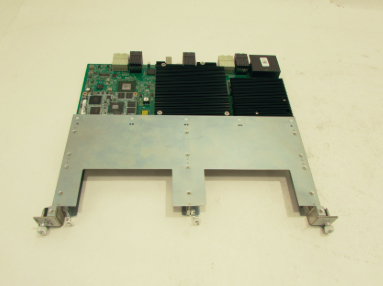
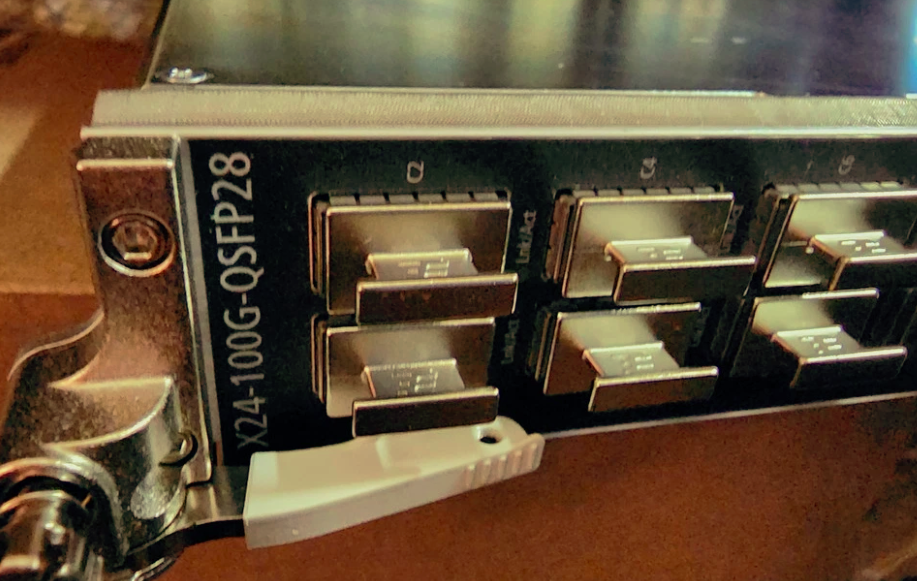
Alcatel Nokia X24-100G QSFP28 Switching Module
The Nokia X24-100G-QSFP28 Switching Module (Part No. 3HE13810AA, RD01, IPUCBPR1AA) is a high-performance networking component designed for carrier-grade and data-center-class switching systems. It belongs to a category of modular switching line cards used in advanced routing and switching platforms, particularly those deployed in telecom infrastructure, hyperscale data centers, and enterprise backbone environments. Below is a detailed, structured overview explaining its architecture, functionality, and practical relevance.
Overview of the Nokia X24-100G-QSFP28 Switching Module
The Nokia X24-100G-QSFP28 module is a line card or switching module that provides high-density 100 Gigabit Ethernet connectivity. It is engineered to support modern network demands such as cloud computing, AI workloads, edge computing, and large-scale IP/MPLS infrastructures.
This module typically integrates into a chassis-based switching or routing system and enables the system to deliver multi-terabit switching capacity using QSFP28 interfaces. QSFP28 (Quad Small Form-factor Pluggable 28) is a widely adopted standard for 100G Ethernet connectivity.
According to available listings, the module is identified as:
- Model: X24-100G-QSFP28
- Part Number: 3HE13810AA
- Variant: RD01
- Hardware ID: IPUCBPR1AA
- Type: Switching Module (eBay)
Key Features and Capabilities
1. High Port Density
The “X24” designation typically indicates 24 QSFP28 ports, each capable of delivering up to 100 Gbps. This results in:
- Total potential bandwidth: up to 2.4 Tbps per module
- Support for breakout configurations (e.g., 4 × 25G per port)
Such density is crucial in environments where rack space and power efficiency are critical.
2. QSFP28 Interface Technology
QSFP28 is a compact, hot-pluggable transceiver standard used for 100G networking. It supports multiple physical layer options:
- 100GBASE-SR4 (short-range multimode fiber)
- 100GBASE-LR4 (long-range single-mode fiber)
- DAC (Direct Attach Copper) cables
- AOC (Active Optical Cable)
Typical QSFP28 modules operate using 4 lanes of 25 Gbps, aggregated into a 100 Gbps link. This modularity allows flexible deployment depending on distance and infrastructure requirements.
3. Carrier-Grade Reliability
Nokia designs its switching modules for telecom-grade deployments, meaning:
- High Mean Time Between Failures (MTBF)
- Redundant architecture compatibility
- Advanced thermal management
- Support for continuous operation (24/7 environments)
These modules are commonly used in mission-critical networks where downtime is unacceptable.
4. Integration with Nokia Switching Platforms
The X24-100G module is not a standalone device—it is meant to operate within Nokia’s switching ecosystems, such as:
- 7220 IXR (data center leaf/spine switches)
- 7250 IXR (deep-buffer aggregation platforms)
These systems support modern network operating systems like SR Linux, which enables automation, programmability, and telemetry. (Nokia Corporation | Nokia)
5. High Throughput and Scalability
Modern Nokia switching platforms can scale up to hundreds of terabits per second. (Nokia Corporation | Nokia)
Within such systems, modules like the X24-100G serve as building blocks, enabling:
- Spine-leaf architectures
- Clos network topologies
- AI/ML cluster networking
- High-frequency trading infrastructure
Technical Context: How It Works
A switching module like the X24-100G performs several core functions:
Packet Forwarding
It processes incoming packets and forwards them based on routing/switching tables.
Traffic Management
Handles congestion, buffering, and Quality of Service (QoS).
Fabric Connectivity
Connects to the switch fabric (backplane) to exchange data with other modules.
ASIC-Based Processing
Uses specialized silicon (network ASICs) for ultra-fast packet handling.
Typical Use Cases
1. Data Center Spine Switches
In a spine-leaf architecture, this module provides high-speed interconnects between leaf switches.
2. Telecom Core Networks
Used in IP/MPLS backbones for carriers delivering internet and mobile services.
3. Cloud Infrastructure
Supports hyperscale environments such as:
- Public cloud providers
- Private enterprise clouds
- AI clusters requiring high east-west bandwidth
4. Edge and 5G Networks
Supports fronthaul/backhaul connectivity in 5G deployments.
Pricing and Market Position
This is not a consumer product—it is enterprise-grade hardware. A listing shows a price around $64,599 for a unit in New in Box condition.
Pricing depends heavily on:
- Licensing
- Support contracts
- Supply chain availability
- Whether optics are included
Related Optical Components
To function, the module requires QSFP28 transceivers. Here’s an example of a compatible optical module:
These transceivers define the physical connectivity (fiber type, distance, wavelength).
Comparison with Similar Modules
| Attribute | AddOn Nokia QSFP28 Module | EDGE Optical 100G QSFP28 | QSFP-100G-ZR4 Coherent Module |
|---|---|---|---|
| Type | Optical transceiver | Optical transceiver | Coherent optical module |
| Speed | 100G | 100G | 100G |
| Use Case | Data center links | Short/medium range | Long-haul DWDM |
| Distance | Up to ~10 km | Short range | Very long range |
| Cost | Medium | Low | Very high |
This table highlights that while the X24 switching module provides the switching fabric, optical modules determine connectivity characteristics.
Advantages
- Extremely high bandwidth density
- Flexible port configuration
- Scalable for large deployments
- Carrier-grade reliability
- Compatible with modern automation tools
Limitations
- Very high cost
- Requires compatible Nokia chassis
- Needs skilled network engineers for deployment
- Optical modules add additional cost
Conclusion
The Nokia X24-100G-QSFP28 Switching Module (3HE13810AA RD01 IPUCBPR1AA) is a high-end, telecom-grade switching component designed for modern high-capacity networks. It provides dense 100G connectivity, integrates into Nokia’s advanced switching platforms, and enables scalable, high-performance networking architectures.
It is best suited for:
- Telecom operators
- Hyperscale cloud providers
- Large enterprises with demanding network requirements
In essence, this module is not just hardware—it is part of a broader ecosystem enabling the future of high-speed, software-driven networking.