Solidigm 122.88TB SSD 2.5″ SBFPF2BV0P12001 | Ultra-High Capacity Enterprise Storage
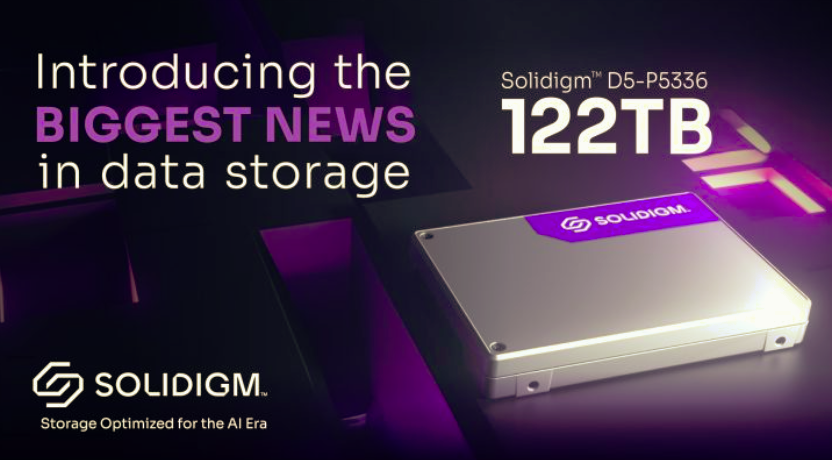
Solidigm, a leading provider of innovative NAND flash memory solutions, announced today the introduction of the world’s highest capacity PCIe solid-state drive (SSD): the 122TB (terabyte) Solidigm D5-P5336 data center SSD. The D5-P5336 doubles the storage space of Solidigm’s earlier 61.44TB version of the drive and is the world’s first SSD with unlimited Random Write endurance for five years — offering an ideal solution for AI and data-intensive workloads. Just how much storage is 122.88TB? Roughly enough for 4K-quality copies of every movie theatrically released in the 1990s, 2.6 times over.
The Solidigm D5-P5336 122.88TB SSD (SBFPF2BV0P12001) represents a watershed moment in the history of data storage. It is not merely an incremental upgrade in capacity; it is a fundamental shift in how data centers, AI research facilities, and cloud service providers approach density, power efficiency, and physical footprint. As the world’s highest-capacity PCIe SSD, this drive challenges the long-standing dominance of Hard Disk Drives (HDDs) in high-density storage tiers and sets a new benchmark for what is possible within a standard 2.5-inch U.2 form factor.
The Architecture of Massive Density
At the heart of the Solidigm D5-P5336 lies its high-density 192-layer QLC (Quad-Level Cell) 3D NAND. While QLC technology was once viewed with skepticism due to concerns over endurance and write speeds, Solidigm has refined the architecture to meet enterprise standards. By stacking 192 layers of flash cells, they have achieved a volumetric efficiency that was unthinkable just a few years ago.
The 122.88TB capacity is particularly significant because it allows for a “shelf-to-shelf” replacement of entire storage arrays. In a standard 1U server chassis, an organization can now fit up to 32 of these drives. This results in nearly 4 Petabytes (PB) of high-speed NVMe storage in a single rack unit. To achieve that same capacity using traditional 20TB HDDs, one would require multiple 4U JBODs, dozens of cables, and significantly more floor space.
Performance Profile: Read-Intensive Mastery
While the sequential read speeds reach an impressive 7,000 MB/s and random reads hit up to 900,000 IOPS, it is important to understand the drive’s intended use case. This is a read-intensive drive, optimized for the “write once, read many” (WORM) nature of modern big data.
- Sequential Throughput: With 7,000 MB/s read and 3,000 MB/s write speeds, it is perfectly suited for streaming large datasets into AI training models or feeding high-resolution video content to Global Content Delivery Networks (CDNs).
- The QLC Advantage: Historically, QLC suffered in random write scenarios. Solidigm mitigates this through advanced firmware and an “Indirection Unit” (IU) optimized for larger block sizes (typically 16KB or 64KB). When aligned with modern software-defined storage (SDS) and object storage platforms, the drive performs with the reliability of more expensive TLC (Triple-Level Cell) drives.
Impact on Artificial Intelligence and Big Data
The AI revolution is fueled by data, and that data must be accessible quickly. The D5-P5336 serves as the ideal foundation for AI Data Lakes. In the past, massive datasets had to be stored on slow HDDs, creating a bottleneck where expensive GPUs (like the NVIDIA H100) sat idle waiting for data to load. By moving these datasets onto 122TB SSDs:
- Ingest time is slashed: Large datasets are ready for processing in minutes rather than hours.
- Training is accelerated: The high random read performance ensures that diverse data points can be fed into the model without latency spikes.
- Checkpointing: Even with its write limitations, the 3,000 MB/s sequential write speed allows for efficient “checkpointing” of AI models during the training process.
Operational Efficiency and Sustainability (TCO)
The most compelling argument for the SBFPF2BV0P12001 is its impact on Total Cost of Ownership (TCO). In modern data centers, the cost of the hardware is often eclipsed by the cost of power, cooling, and real estate.
- Power Reduction: Solidigm’s data suggests that moving from a mixed HDD/SSD infrastructure to an all-flash D5-P5336 array can reduce power consumption by up to 80% to 90%. SSDs lack the mechanical motors of HDDs, which draw significant power even when idle.
- Cooling Efficiency: Less power consumption translates directly to less heat generation. This reduces the strain on data center HVAC systems, further lowering operational expenses (OPEX).
- Physical Footprint: By consolidating 4PB of storage into 1U of space, companies can delay the need for multi-million dollar data center expansions. One rack of Solidigm-equipped servers can replace an entire row of legacy HDD racks.
Endurance and Reliability
A common concern with a 122TB drive is: “What happens if it fails?” Solidigm has addressed this through robust enterprise-grade features:
- Endurance (DWPD): The drive is rated for 0.6 Drive Writes Per Day (DWPD). While this may seem low compared to high-endurance drives (3+ DWPD), 0.6 DWPD on a 122TB drive equals roughly 73 Terabytes of writes every single day for five years. For most enterprise workloads, this is more than sufficient.
- Data Integrity: The drive includes end-to-end data path protection, power-loss protection (via integrated capacitors), and an MTBF (Mean Time Between Failures) of 2 million hours.
- Physical Durability: Without moving parts, the drive is immune to the vibration issues that often plague high-density HDD enclosures. It can withstand significant shocks (up to 1,000G) without data loss.
Strategic Market Positioning
Currently, the SBFPF2BV0P12001 is positioned at the top of the market. Its pricing—ranging from $25,000 to $45,000 depending on the vendor—reflects its status as a premium, niche product. However, for organizations operating at the “edge” (where space and power are at a premium) or those running massive Object Storage or CDN nodes, the price per terabyte is increasingly competitive when factoring in the saved costs of servers, power, and maintenance.
Conclusion: The Future of the All-Flash Data Center
The Solidigm 122.88TB SSD is more than a storage device; it is an enablement tool. It allows researchers to keep larger datasets “warm” and accessible, enables media companies to stream 8K content globally with zero lag, and allows cloud providers to offer unprecedented density.
As data generation continues to explode, the industry is moving toward a future where spinning disks are relegated to “cold” archival storage, while the “active” layer is dominated by high-density QLC drives like the P5336. This drive isn’t just about having more space; it’s about making that space smarter, faster, and more sustainable.
Would you like to see a detailed breakdown of the cost-per-gigabyte compared to 30.72TB or 61.44TB alternatives?