
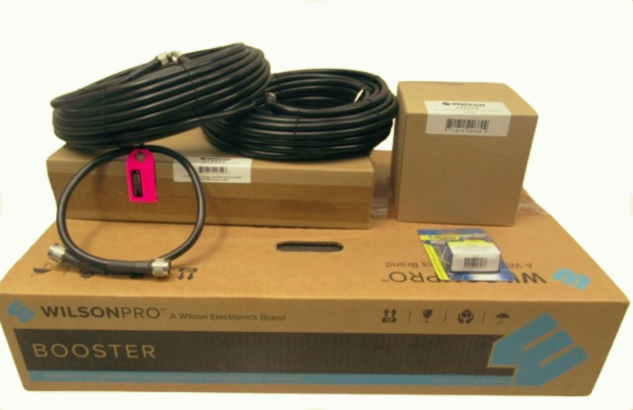
WilsonPro PRO 710i 5G Band 71 Industrial Amplifier (460064) | Boost Connectivity
The WilsonPro Pro 710i (Model 460064) represents a specialized evolution in cellular signal technology. Unlike traditional wide-band boosters that attempt to amplify every frequency at once, the 710i is a surgical tool designed for a specific mission: dominating the Band 71 (600 MHz) spectrum. [1, 2, 3]
Below is a comprehensive breakdown of why this industrial amplifier is a cornerstone for modern 5G connectivity in large-scale environments.
1. The Power of Band 71 (600 MHz)
To understand the Pro 710i, you must understand Band 71. Primarily utilized by T-Mobile, this low-frequency spectrum is the “workhorse” of 5G and extended-range 4G LTE. [4]
- Penetration: Low-frequency waves (600 MHz) travel further from the tower and penetrate obstacles like concrete, brick, and low-e glass much better than high-frequency mid-band or mmWave signals.
- Rural Connectivity: In remote areas where towers are miles apart, Band 71 is often the only signal available.
- Industrial Advantage: The Pro 710i takes this resilient signal and amplifies it to ensure that even the deepest interior “dead zones” of a warehouse or hospital receive consistent high-speed data.
2. Industrial-Grade Specs for Massive Scale
The “Industrial” designation isn’t just marketing; it refers to the FCC classification under which this device operates. [5]
- 90 dB Max Gain: Consumer boosters are capped at 65-72 dB of gain. The Pro 710i offers significantly more “reach,” allowing it to take a faint outside signal and broadcast it over a much larger footprint.
- Coverage Footprint: Under ideal conditions, a single unit can cover up to 100,000 square feet. For context, that is roughly the size of two football fields.
- 25 dBm Uplink/Downlink: High output power ensures that the signal doesn’t just reach your phone, but your phone’s signal is strong enough to reach back to the distant cell tower. [6, 7, 8]
3. Key Technology: XDR and Software Control
One of the biggest hurdles in cellular amplification is “oscillation” or “overload.” If a cell tower is too close, it can overwhelm the amplifier, causing it to shut down to protect the carrier network.
- XDR (eXtended Dynamic Range): This technology allows the Pro 710i to automatically adjust its gain in real-time. It never “shuts down” due to a strong signal; it simply scales back precisely to maintain peak performance without interference.
- Color LCD Display: The front-facing screen provides immediate feedback on signal strength, gain levels, and any potential installation errors, making the setup process far more intuitive than older “dip-switch” models. [9, 10]
4. Strategic Integration: Standalone vs. Parallel
The Pro 710i is rarely the only booster in a building. Because it is a single-band amplifier, it is most effective when used in a Parallel Installation: [11]
- The Hybrid Approach: Most IT managers pair the Pro 710i with a multi-band amplifier (like the WilsonPro 1100 or 4000). The multi-band unit handles standard 4G frequencies (Bands 2, 4, 5, 12/17), while the 710i is “daisy-chained” or combined to provide a dedicated “lane” for Band 71 5G.
- Dedicated 5G Lane: This ensures that as users transition to 5G devices, the network infrastructure is already capable of handling the high-bandwidth requirements of the 600 MHz spectrum.
5. Compliance and FCC Regulations
Because this is an Industrial Class B device, there are specific legal requirements:
- Carrier Approval: Before powering on, you are technically required to have consent from the wireless provider (T-Mobile).
- Professional Installation: These units are not “plug-and-play” for homeowners. They require N-Female connectors, 50-ohm cabling (like Wilson400), and strategic antenna placement to prevent feedback loops. [12, 13]
6. Target Use Cases
- Warehouses & Logistics: Metal roofs and heavy racking often block signals. The 710i brings T-Mobile’s long-range 5G deep into the loading docks.
- Underground Parking: Low-frequency signals are the only ones capable of reaching subterranean levels effectively.
- Hospitals & Schools: Large, sprawling campuses with thick walls require the 90 dB gain of an industrial unit to ensure emergency communications remain active.
Summary of Benefits
- Future-Proof: Built specifically for the 5G era.
- Reliability: XDR technology prevents system crashes.
- Expansion: Can be scaled using splitters and multiple indoor antennas.
- Specialized: Offers the highest gain available for the 600 MHz band. [14]
The WilsonPro Pro 710i is less of a “booster” and more of a cellular infrastructure component. For enterprises relying on T-Mobile’s 5G network, it is the most robust solution for eliminating indoor dead zones. [15]
Would you like to see a list of compatible antennas and cabling required to complete a full installation kit for this unit?
[1] https://www.wilsonsignalbooster.com
[2] https://www.wilsonamplifiers.com
[3] https://www.wilsonamplifiers.com
[4] https://www.wilsonconnectivity.com
[5] https://www.adiglobaldistribution.us
[6] https://powerfulsignal.com
[7] https://www.wilsonsignalbooster.com
[8] https://powerfulsignal.com
[9] https://powerfulsignal.com
[10] https://www.wilsonamplifiers.com
[11] https://www.wilsonamplifiers.com
[12] https://www.signalbooster.com
[13] https://powerfulsignal.com