Cisco NEXUS 9300 ACI NX-OS LEAF/SPINE 64P 40/100G QSFP28
64 Ports, One Fabric:
The Nexus 9364C-GX
A 2RU switch built to be either half of a spine-leaf pair — 64 fixed 40/100G QSFP28 ports, 12.8 Tbps of switching capacity, and a single ASIC that runs equally well in Cisco ACI or plain NX-OS mode.
Most switches are built to be one thing. The Nexus 9364C-GX is built to be interchangeable — the same fixed-ASIC 2RU box can sit at the top of a fabric as a spine, or down at the rack as a leaf, running either Cisco’s intent-based ACI fabric or traditional NX-OS without a hardware swap. That flexibility, paired with 64 wire-rate 40/100G ports, is what makes it one of the more common building blocks in modern spine-leaf data centers.
The core numbers // hardware
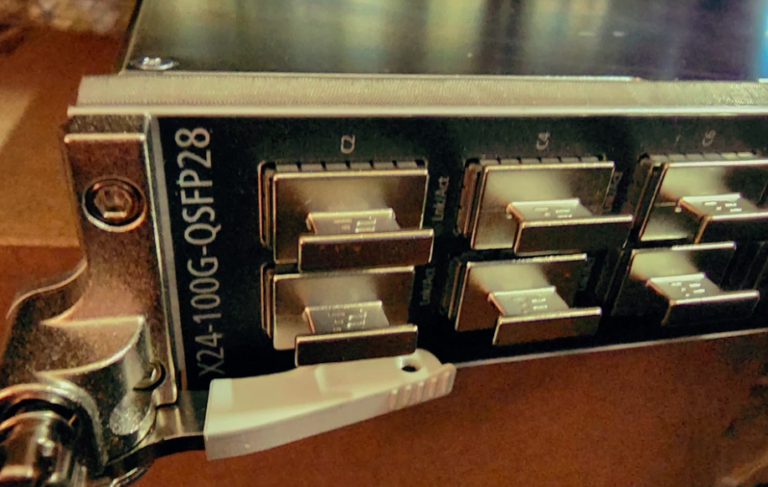
Built on Cisco’s Cloud Scale ASIC, the 9364C-GX packs 64 fixed QSFP28 cages into a 2-rack-unit chassis — no line cards, no modularity, just density. Every port runs at 40 or 100 Gigabit Ethernet natively, with breakout support down to 10G, 25G, and 50G where the fabric needs finer-grained fan-out.
| Model | N9K-C9364C-GX |
| Port configuration | 64 × 40/100G QSFP28 |
| Switching capacity | 12.8 Tbps |
| Forwarding rate | Over 4.3 Bpps |
| Form factor | 2RU |
| Operating modes | Cisco ACI or Cisco NX-OS |
| ACI role support | Spine and Leaf |
| Power consumption | 811 W typical / 1622 W max |
| Fan redundancy | 3+1 hot-swappable |
| Airflow | Port-side intake and exhaust |
| MTBF | 237,760 hours |
One ASIC, two operating models // flexibility
Every Nexus 9000 ships as a single binary image, and the 9364C-GX is no exception. Point it at a Cisco APIC and it becomes part of a policy-driven ACI fabric with centralized automation. Leave it in standalone NX-OS mode and it behaves like any traditional data-center switch — VXLAN EVPN, BGP, the works — for teams not ready to adopt intent-based networking wholesale.
- FABRIC Native spine or leaf role in the same physical unit
- OVERLAY VXLAN EVPN with hierarchical multi-site support
- SCALE 64-way ECMP for nonblocking Layer 3 fat-tree designs
- OPS Hot and cold patching, per-process fault isolation in NX-OS
- SEC Wire-rate MACsec on select port ranges
Why breakout matters: although all 64 ports are native 40/100G, they support 4×10G and 4×25G breakout on select ports plus 2×50G everywhere. That means one 9364C-GX leaf can serve a rack of mixed 10G, 25G, and 100G endpoints without a separate switch model for each speed tier.
Where it fits in the GX lineup // comparison
The GX series spans a range of port counts and speed mixes. The 9364C-GX is the highest-density all-QSFP28 option, while siblings trade port count for higher per-port speeds or mixed-speed cages:
| Model | Ports | Capacity | Focus |
|---|---|---|---|
| 9364C-GX | 64× QSFP28 | 12.8 Tbps | Max 40/100G port density |
| 93600CD-GX | 28+8 mixed | 12 Tbps | QSFP-DD for 400G migration |
| 9332C | 32× QSFP28 | 6.4 Tbps | Compact 1RU spine |
| 9336PQ | 36× QSFP+ | 2.88 Tbps | Legacy 40G-only spine |
The bottom line // takeaway
The Nexus 9364C-GX isn’t chasing exotic speeds — it’s chasing uniformity. 64 identical 40/100G ports, one ASIC, two operating models, and the ability to serve as either end of a spine-leaf pair means fewer SKUs to plan around and a straightforward path from 10G server racks up to a fully nonblocking 100G core.