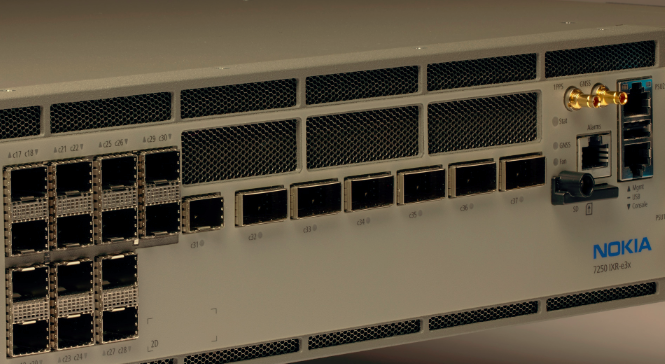
Nokia 7750 SR-s IOM-s: 3.0 Tb/s Core Routing Module
Nokia 7750 SR-s IOM-s: 3.0 Tb/s Core Routing Module Explained
A field guide to the Nokia 7750 SR-s Input/Output Module (IOM-s) — its dual FP4 complex architecture, MDA-s slot behavior, Core Router (CR) feature licensing, and the impedance panel you need for every unpopulated slot.
Impedance Panel Part No. 3HE14027AAIf you run, plan, or maintain a Nokia 7750 SR-s core routing deployment, the IOM-s is the workhorse that decides how much traffic your chassis can actually push. It is the module that turns a 7750 SR-s chassis slot into a routing engine — pairing Nokia’s FP4 network processor silicon with two pluggable Modular Data Adapter (MDA-s) bays to deliver dense, forwarding-rich edge and core capacity. This post walks through what the 3.0 Tb/s full-duplex IOM-s variant actually is, how its dual FP4-complex design scales, what the Core Router (CR) feature set unlocks, and why the correct impedance panel matters more than most engineers expect.
What the IOM-s Actually Is
The IOM-s is a modular line card that slots into the 7750 SR-s chassis family (SR-7s, SR-14s and related modular platforms) and hosts up to two MDA-s adapters. Rather than a fixed-port card, it is a capacity platform: the same physical board can be licensed and populated differently depending on how much forwarding bandwidth a given site needs. The variant covered here ships with two FP4 complexes on-board, giving it a full-duplex forwarding ceiling of 3.0 Tb/s before any intelligent fan-in/fan-out (iFIFO) headroom is applied.
Dual FP4 Complex Architecture
Each FP4 complex on the IOM-s is an independent forwarding engine with its own packet buffering and lookup resources. Splitting the board into two complexes rather than one larger engine gives Nokia’s SR OS finer-grained control over how MDA-s bandwidth is allocated: each MDA-s slot can be mapped to its own complex, or traffic can be balanced across both depending on the port and service mix. This is the same architectural pattern used across the wider 7750 SR-s IOM-s family, just scaled differently depending on how many complexes and how much per-complex bandwidth a given SKU includes.
Illustrative comparison based on published Nokia 7750 SR-s IOM-s capacity tiers. Confirm exact licensed capacity for your target release and chassis with your Nokia documentation or a Sunol Tech engineer before ordering.
MDA-s Slots and Pay-As-You-Grow Licensing
Each IOM-s accepts two pluggable MDA-s modules, and Nokia’s licensing model lets operators start small and scale capacity in software as traffic grows — without swapping hardware. That flexibility is one of the main reasons the SR-s platform gets chosen for edge aggregation sites that expect to grow, and for core sites where a single board needs to absorb multiple growth cycles. The tradeoff is that every MDA-s slot must be either populated with a real adapter or covered by a certified blank — more on that below.
Where the IOM-s Fits
- 7750 SR-7s and SR-14s modular chassis
- Core and edge routing roles requiring FP4 forwarding
- Sites planning capacity growth via software licensing
- Deployments standardizing on SR OS across the fleet
Core Router (CR) Feature Set
- Full IP/MPLS routing and label switching
- Segment routing and traffic engineering support
- Scaled route table and forwarding policy capacity
- QoS, filtering, and hardware queue scaling per license
Data Sheet & Technical Specifications
| Attribute | Specification |
|---|---|
| Module family | Nokia 7750 SR-s IOM-s (Input/Output Module) |
| Forwarding capacity | 3.0 Tb/s full-duplex (FD), based on two FP4 complexes |
| Processing silicon | Nokia FP4 network processor, 2x complexes per module |
| MDA-s slots | 2 pluggable Modular Data Adapter (MDA-s) bays per IOM-s |
| Feature set | Core Router (CR) — full IP/MPLS, SR-TE, scaled routing |
| Fan-in/fan-out | iFIFO support for burst absorption above nominal FD rate |
| Licensing model | Pay-as-you-grow, software-upgradable capacity tiers |
| Operating system | Nokia SR OS, common across 7750 SR-s platform family |
| Chassis compatibility | 7750 SR-7s / SR-14s and related SR-s modular systems |
| Required accessory | Impedance panel 3HE14027AA in every unpopulated MDA-s slot |
Specifications summarized from Nokia’s published 7750 SR-s IOM data sheet and platform documentation. Always validate exact capacity tiers, release support, and part compatibility against current Nokia documentation or your Nokia account team before final design.
Why the Impedance Panel Matters
Impedance panels are not cosmetic blanks. They maintain the electrical and thermal characteristics the chassis backplane and fabric interconnect expect on every slot, whether populated or not. Leaving a slot uncovered can affect signal integrity on adjacent adapters, disrupt front-to-back airflow across the card cage, and in some configurations trigger alarms or degrade neighboring MDA-s performance. For the IOM-s covered in this post, the correct panel is part number 3HE14027AA, and Nokia specifies it be installed in every open MDA-s bay for the duration the slot sits empty.
This is a detail that gets missed surprisingly often on rack-and-stack projects, spares kits, and lab builds — teams order the IOM-s and MDA-s adapters, but forget the panel for the second slot when only one adapter ships initially. Building the panel into your BOM from day one avoids a return trip to close out a punch-list item during turn-up.
Sourcing IOM-s Modules and Impedance Panels Through Sunol Tech
Sunol Tech stocks Nokia 7750 SR-s IOM-s modules, MDA-s adapters, and the matching impedance panels — including 3HE14027AA — as new, factory-sealed, and quality-tested refurbished units. Whether you’re building out a new core site, adding capacity to an existing SR-7s/SR-14s deployment, or filling out a spares kit ahead of a maintenance window, our team can quote complete, compatibility-checked bundles rather than leaving you to piece together part numbers on your own.
Every unit that leaves our facility is visually inspected, functionally tested where applicable, and paired with the correct accessories — impedance panels, cable management, and mounting hardware — so the box that arrives on your dock is ready to rack, not a partial kit. Lead times are typically faster than OEM channel quotes, and we support both single-unit orders and larger multi-site rollouts.
Get Pricing on the Nokia 7750 SR-s IOM-s Today
Send us your chassis type, quantity, and MDA-s pairing and we’ll return a formal quote — including impedance panels, lead time, and warranty terms.
What to Include in Your RFQ
- Nokia 7750 SR-s chassis model (SR-7s, SR-14s, etc.)
- IOM-s quantity and target capacity tier
- MDA-s types needed per slot
- Impedance panels required (3HE14027AA) for open slots
- Delivery location and target install date
Why Request From Sunol Tech
- New and tested-refurbished inventory in stock
- Compatibility-checked bundles — no missing accessories
- Competitive lead times vs. standard OEM channel
- Warranty-backed, ESD-safe handling and packaging
Prefer to talk it through first? Email [email protected] with your part list or chassis diagram and a Sunol Tech engineer will confirm compatibility before you commit to a BOM.
Frequently Asked Questions
Can the IOM-s run with only one MDA-s installed?
Yes — the two MDA-s slots on the IOM-s do not need to be populated simultaneously. A single MDA-s can be installed while the second slot is covered by the 3HE14027AA impedance panel, and a second adapter can be added later without replacing the IOM-s itself.
Does the Core Router (CR) feature set require a separate license?
The IOM-s ships with a base capacity tier, and feature sets such as CR are enabled through Nokia’s software licensing model on top of the hardware. Confirm your target license package against current Nokia documentation, since licensing structures are periodically revised across SR OS releases.
Is 3HE14027AA specific to this IOM-s variant?
Impedance panels are matched to the specific IOM/MDA slot geometry of the card family they’re designed for, so always confirm the panel part number against your exact IOM-s hardware revision. Our team can verify this against your BOM before you order.
Ready to move forward? Reach the Sunol Tech team any time at [email protected] with your chassis details, and we’ll turn around a complete, compatibility-verified quote for your Nokia 7750 SR-s IOM-s deployment — MDA-s adapters, impedance panels, and all.