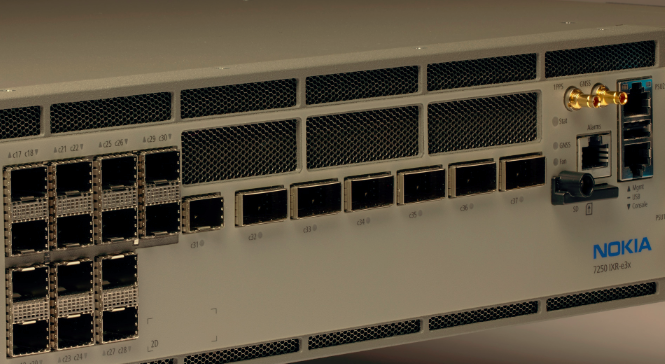
Nokia MPT-HLC XCVR L6 GHZ Transceiver
Nokia MPT-HLC L6 GHz Transceiver: Dependable Links, Mile After Mile
A proven point-to-point microwave transceiver from Nokia’s 9500 MPR platform, built to keep licensed backhaul links running reliably across carrier and private networks.
Not every network connection runs on fiber — and it doesn’t need to. For countless carrier and enterprise backhaul links, licensed microwave remains the fastest, most cost-effective way to move traffic between towers, buildings, and remote sites. The Nokia MPT-HLC XCVR L6 GHz (part number 3DB19060AA) is a workhorse transceiver built for exactly that job, operating in the licensed 5725–6425 MHz band as part of Nokia’s long-standing 9500 MPR microwave packet radio platform.
This is the base variant in a well-established product family — no diversity, no combiner, no high-power boost — making it a straightforward, cost-effective choice for standard point-to-point links where a simpler configuration gets the job done. Let’s walk through the details, see where it fits into Nokia’s broader microwave portfolio, and cover how to get pricing.
Why Operators Still Choose Microwave
Licensed microwave backhaul has stayed relevant for decades because it solves a problem fiber often can’t: getting high-capacity connectivity to a site quickly, without trenching, permitting delays, or right-of-way negotiations. The MPT-HLC series fits into Nokia’s Wavence portfolio, integrating with the Network Services Platform for consistent, centralized management across an operator’s entire packet microwave network.
Frequency Band
Licensed L6 GHz band, 5725–6425 MHz operating range.
Configuration
Standard transmitter and receiver configuration — base variant, no diversity.
Platform Family
Part of the Nokia 9500 MPR (Microwave Packet Radio) product line.
Market
ANSI-market variant (MPT-HLC); ETSI equivalent is designated MPT-HLS.
Network Integration
Integrates with Nokia Network Services Platform and Wavence MSS for unified operations.
Product Family
Part of a broader lineup including HP, Combiner, and MPT-HLC Plus variants.
Full Data Sheet
| Spec | Detail |
|---|---|
| Part Number | 3DB19060AA |
| Product Name | MPT-HLC XCVR L6 GHz |
| Platform | Nokia 9500 MPR (Microwave Packet Radio) |
| Frequency Range | 5725–6425 MHz (L6 GHz band) |
| Transmitter Configuration | Standard |
| Receiver Configuration | Standard (without diversity) |
| Market Variant | ANSI (MPT-HLC); ETSI equivalent is MPT-HLS |
| Related Variants | 3DB19060BA (w/ Combiner), 3DB19060CA (HP), 3DB19060DA (HP w/ Combiner) |
| Enhanced Option | MPT-HLC Plus (3DB19060EA/GA) for higher modulation & system gain |
| Management | Integrates with Nokia Network Services Platform / Wavence MSS |
Note: Detailed RF specifications (output power, receiver sensitivity, modulation schemes, capacity) vary by firmware and system configuration — confirm exact figures against Nokia’s official MPT-HLC unit data sheet before finalizing a link budget or network design.
Finding the Right Variant
Here’s a friendly look at how the base 3DB19060AA compares to other options in the same L6 GHz family, in case a diversity, combiner, or high-power configuration fits your link better.
- Cellular Tower Backhaul — 37%
- Private Network Links — 26%
- Rural / Remote Connectivity — 22%
- Enterprise Site-to-Site Links — 15%
Approximate distribution of common deployment scenarios for L6 GHz licensed microwave links.
Popular Use Cases
Reliable Technology With a Long Track Record
The MPT-HLC series isn’t a flashy new product — and that’s actually part of its appeal. It’s a mature, widely deployed transceiver family with a large installed base across carrier and enterprise networks, which means proven reliability, a healthy secondary market for spares, and broad technician familiarity. For network teams managing multi-year infrastructure, that maturity translates directly into lower operational risk.
What makes the platform genuinely flexible is the range of configurations available within the same L6 GHz frequency block. Need extra output power for a longer or more challenging path? The HP variant steps up transmit power. Need to combine two radios onto a single antenna to conserve tower space? The combiner variant handles that. Need higher-order modulation and better system gain for maximum spectral efficiency? The MPT-HLC Plus family delivers that without changing frequency bands. That means network planners can standardize on the L6 GHz spectrum allocation while still tailoring the actual hardware to each specific link’s distance, capacity, and space constraints.
Integration with Nokia’s Network Services Platform and Wavence MSS also matters more than it might seem at first glance. Rather than managing each microwave link in isolation, operators get centralized visibility and control across their entire packet microwave network — which becomes increasingly valuable as a network grows from a handful of links to hundreds of them spread across a wide geographic footprint.
For network engineers evaluating backhaul options where fiber isn’t practical or cost-effective, the MPT-HLC L6 GHz transceiver represents a dependable, well-supported choice backed by one of the most established names in microwave transport.
Ready to Plan Your Link?
Pricing, lead times, and the right variant for your specific path (base, combiner, HP, or Plus) depend on distance, capacity requirements, and site conditions. Our team can help you land on the right configuration and get accurate, current pricing.
Request a Quote 🎈
Tell us about your link and we’ll put together pricing and configuration guidance for the Nokia MPT-HLC XCVR L6 GHz (3DB19060AA) or the variant that best fits your path.
When you email us, please include:
- ✅ Quantity of units needed
- ✅ Approximate link distance
- ✅ Capacity / throughput requirements
- ✅ Preferred delivery timeline
- ✅ Company name and best contact number
Prefer to write it yourself? Reach us directly at [email protected]