NVIDIA Tesla H100 80GB Deep Learning GPU!
NVIDIA Tesla H100: The Ultimate 80GB Deep Learning GPU
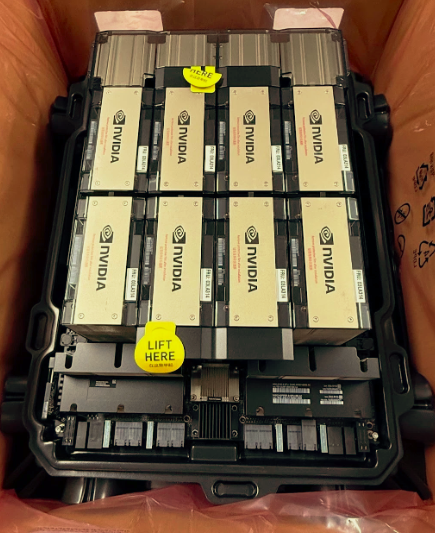
The NVIDIA Tesla H100 80GB represents one of the most powerful accelerators ever built for artificial intelligence (AI), deep learning, and high-performance computing (HPC). Based on NVIDIA’s groundbreaking Hopper architecture, the H100 is engineered to handle the explosive growth of large-scale models such as large language models (LLMs), recommendation systems, and scientific simulations. With massive memory capacity, cutting-edge Tensor Core technology, and unmatched scalability, the H100 has become the backbone of modern AI infrastructure across enterprises, research labs, and cloud providers.
Architectural Breakthrough: Hopper
At the heart of the H100 lies the Hopper architecture, fabricated using an advanced 5 nm process and packing around 80 billion transistors (TechPowerUp). This architecture introduces several innovations that fundamentally change how AI workloads are executed.
One of the most important features is the Transformer Engine, designed specifically for deep learning models such as GPT-style transformers. This engine dynamically adjusts precision (including FP8), enabling faster computation while maintaining model accuracy. As a result, the H100 can accelerate transformer-based models by orders of magnitude compared to previous GPUs (NVIDIA).
The GPU also includes fourth-generation Tensor Cores, which significantly boost performance across a wide range of numerical formats, including FP64, FP32, FP16, INT8, and FP8. These cores are the driving force behind the H100’s ability to train and deploy AI models at unprecedented speed.
Massive 80GB High-Bandwidth Memory
One of the defining features of the Tesla H100 is its 80GB of HBM (High Bandwidth Memory). This memory is connected via a 5120-bit interface, delivering over 2 TB/s of bandwidth (TechPowerUp).
Why does this matter? Modern AI models—especially LLMs—require enormous datasets and parameter sizes. Traditional GPUs often run into memory bottlenecks, forcing developers to split workloads across multiple devices. The H100’s large memory capacity reduces this need, enabling:
- Training of larger models on a single GPU
- Faster data throughput
- Reduced communication overhead in distributed systems
This makes it particularly valuable for training trillion-parameter models and running inference on complex neural networks.
Performance: A Giant Leap Forward
The H100 delivers a dramatic performance increase over its predecessor, the A100. NVIDIA claims:
- Up to 4× faster training performance on large models like GPT-3 (NVIDIA)
- Up to 30× faster inference performance for large-scale AI systems (NVIDIA)
- Significant gains in HPC workloads, including up to 7× speedups in certain scientific applications (NVIDIA)
In raw compute terms, the H100 offers:
- ~51 TFLOPS FP32 performance
- Over 200 TFLOPS FP16 performance
- Thousands of TFLOPS with Tensor Core acceleration (TechPowerUp)
These numbers translate into faster training cycles, quicker experimentation, and lower operational costs for AI teams.
Scalability and Interconnects
AI workloads rarely run on a single GPU. Instead, they rely on clusters of GPUs working together. The H100 is designed with this in mind.
It supports NVLink, offering up to 900 GB/s of GPU-to-GPU bandwidth, enabling multiple GPUs to act as a unified system (NVIDIA). Combined with high-speed networking technologies like InfiniBand, this allows data centers to scale efficiently from a few GPUs to thousands.
Additionally, the H100 uses PCIe Gen5, doubling the bandwidth of previous generations and ensuring faster communication with CPUs and other system components.
Transformer Engine and FP8 Precision
A standout innovation in the H100 is its support for FP8 precision, a new numerical format optimized for AI. Traditional formats like FP16 and FP32 are accurate but computationally expensive. FP8 reduces memory usage and increases speed without significantly sacrificing accuracy.
The Transformer Engine automatically determines when to use FP8 versus higher precision formats, making it easier for developers to optimize performance without rewriting code. This is particularly beneficial for:
- Natural language processing (NLP)
- Generative AI models
- Recommendation systems
Multi-Instance GPU (MIG) Technology
Another key feature is Multi-Instance GPU (MIG) capability. This allows a single H100 GPU to be partitioned into multiple smaller instances, each acting as an independent GPU.
Benefits include:
- Better resource utilization
- Improved isolation for multi-tenant environments
- Flexibility for cloud providers
For example, a single H100 can be divided into up to seven independent GPU instances, each with dedicated memory and compute resources (NVIDIA).
Security and Confidential Computing
The H100 is also the first GPU to feature confidential computing capabilities at the hardware level. This ensures that data remains encrypted and secure during processing.
This is particularly important for industries like:
- Healthcare
- Finance
- Government
By enabling secure AI workloads, the H100 opens the door to new applications that require strict data privacy.
Real-World Applications
The NVIDIA Tesla H100 is used across a wide range of industries and applications:
1. Generative AI and LLMs
The H100 powers large language models such as GPT-style systems, enabling faster training and real-time inference for chatbots, virtual assistants, and content generation.
2. Scientific Research
Researchers use the H100 for simulations in physics, climate modeling, genomics, and drug discovery. Its high FP64 performance and DPX instructions accelerate complex calculations.
3. Data Analytics
With massive memory bandwidth and GPU-accelerated frameworks like RAPIDS, the H100 enables faster data processing and real-time analytics.
4. Autonomous Systems
From self-driving cars to robotics, the H100 supports advanced perception and decision-making models.
Comparison with Previous Generations
Compared to the A100 (Ampere architecture), the H100 offers:
- Higher memory bandwidth
- New FP8 precision support
- Transformer Engine acceleration
- Improved interconnect speeds
- Better scalability
These improvements make the H100 not just an incremental upgrade but a transformative leap in GPU computing.
Power and Efficiency
Despite its immense performance, the H100 is designed with efficiency in mind. The PCIe version has a TDP of around 350W, while higher-performance SXM variants can go up to 700W depending on configuration (TechPowerUp).
This balance of power and efficiency is crucial for data centers, where energy consumption is a major concern.
The Future of AI Computing
The NVIDIA Tesla H100 is more than just a GPU—it’s a platform for the future of computing. By combining cutting-edge hardware with a robust software ecosystem (CUDA, cuDNN, TensorRT), it enables developers to push the boundaries of what’s possible in AI.
As models continue to grow in size and complexity, GPUs like the H100 will play a central role in enabling breakthroughs across industries.
Conclusion
The NVIDIA Tesla H100 80GB stands as the ultimate deep learning GPU, delivering unmatched performance, scalability, and innovation. With its Hopper architecture, Transformer Engine, massive memory, and advanced interconnects, it is uniquely positioned to handle the demands of modern AI workloads.
Whether powering generative AI, accelerating scientific discovery, or enabling real-time analytics, the H100 represents a new era of accelerated computing—one where the limits of performance are continually redefined.